How to read your price position against competitors
Understand competitive price position with three essential metrics, practical actions and always-on competitor monitoring from Prime Solutions.
Knowing a competitor’s price for one product is easy. Knowing where all of your products stand against all of your competitors, every day, is a different problem. Price position is the idea that makes it manageable.
What price position means
For any product, collect the prices of every seller that offers it. Your price position is where your price falls in that list: cheapest, most expensive or somewhere between.
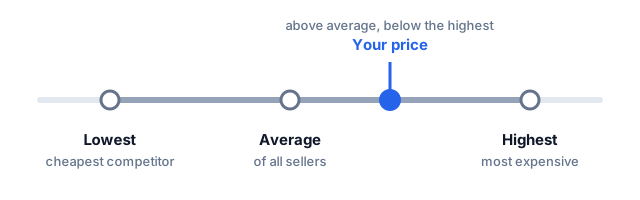
One product’s position tells you little. The pattern across a category tells you a great deal.
Three numbers for every product
The lowest competitor price. This is the price a shopper who compares will see first. The distance between it and your price is your exposure.
The market average. This shows whether you are priced with the market or apart from it. A product far above the average needs a reason: better service, faster delivery or stock when others have none.
The number of sellers in stock. A low price from a seller with no stock is not competition today. Stock availability turns a price list into a realistic picture.
Which gaps deserve action
Not every gap is a problem. A useful way to sort them:
- You are cheapest by a wide margin. You may be giving away margin. Test a small increase.
- You are close to the lowest price. A small move changes your position. These products repay attention.
- You are far above the market, and it has stock. Either the price or the advertising spend on that product is wrong.
- You are far above the market, and it has no stock. Leave the price alone. You are the only place to buy.
Sorting a whole catalog this way by hand is not realistic, which is why the comparison needs to be automatic.
Position changes daily
Competitors change prices and run out of stock without telling you. A position that was true on Monday can be wrong by Wednesday. Two habits help:
- Alerts on thresholds. Decide in advance which changes matter, for example a competitor undercutting you on a top product, and be told when they happen.
- History. Past prices show whether a competitor’s cut is a one-day promotion or a new level. The right response differs.
Using position beyond pricing
Price position also tells marketing where to spend. Advertising a product on which you are clearly more expensive sends shoppers to compare and leave. Products where you are well positioned are the ones to promote.
PriceTrack collects these numbers for your catalog around the clock, keeps the history and sends the alerts.
How Prime Solutions turns price data into action
PriceTrack compares your catalog with competing sellers, filters out out-of-stock noise, keeps price history and alerts your team when a meaningful change occurs. This turns competitor price monitoring from a spreadsheet exercise into a repeatable workflow for pricing, merchandising and marketing teams.
Use the data with business context: protect margin on products where you are already the lowest, review paid traffic when a comparable competitor is consistently cheaper, and promote products where your price, availability or service gives shoppers a clear reason to choose you. Exportable reports and scheduled email summaries help the team act on the same view of the market.
Quick answer: what is competitive price position?
Competitive price position is the place your product price holds among comparable sellers that have stock. The lowest price, market average, seller availability and price history together tell you whether to change price, change promotion or leave the product alone.